
Frederick Minta
9 November 2026 · 3 min read
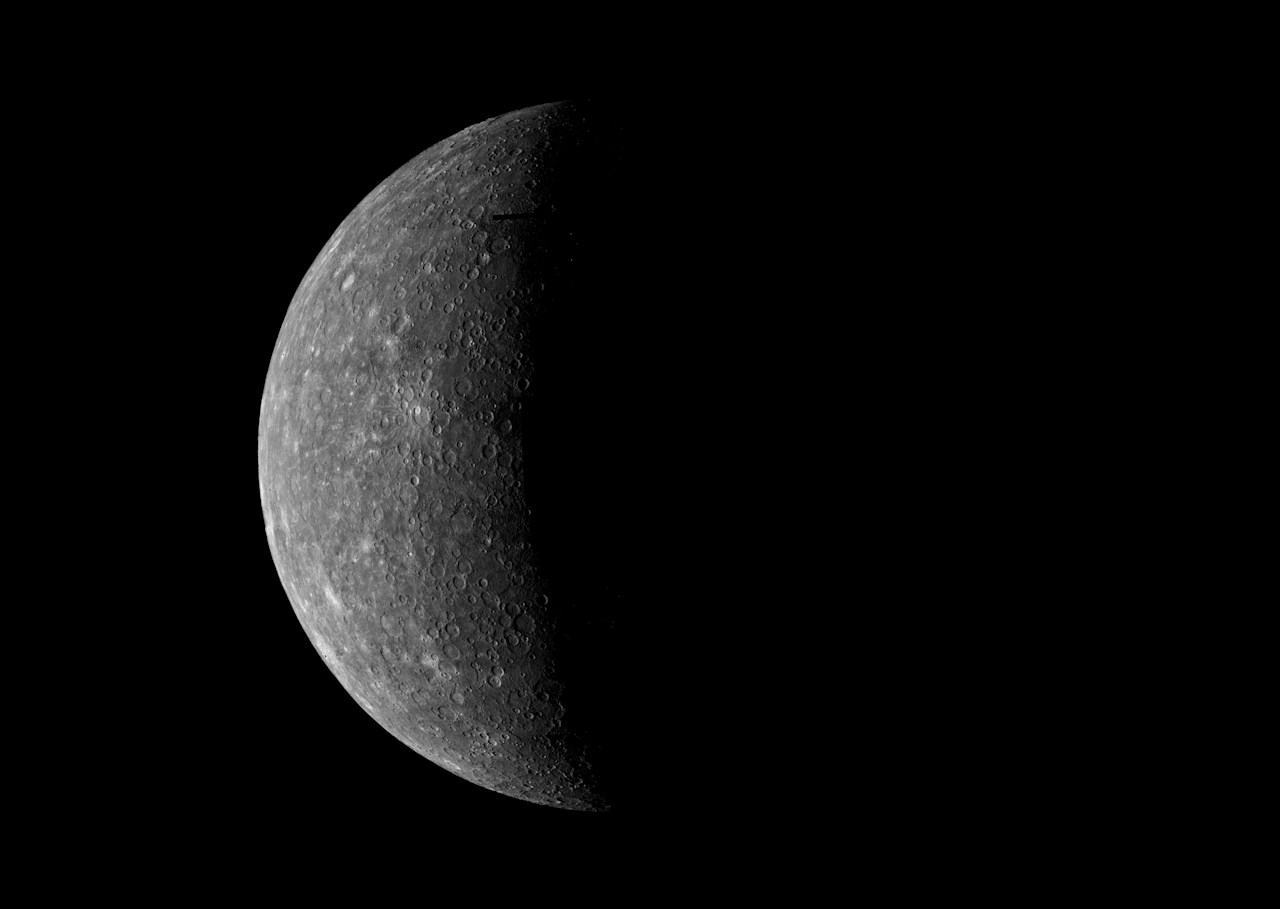
Mercury, the smallest planet and the closest to the Sun. Image: NASA, via Unsplash.
On 21 November 2026, a spacecraft called BepiColombo is due to slip into orbit around Mercury, the smallest planet and the one closest to the Sun. It left Earth in October 2018. That is right: it has been travelling for eight years to reach a planet that is, at times, closer to us than Mars.
Why does it take so long?
You might think going towards the Sun is easy, because the Sun pulls everything in. That is exactly the problem. As a spacecraft falls towards the Sun it speeds up, and to stay at Mercury instead of shooting past, it has to slow down a lot.
BepiColombo saved fuel by flying past Earth once, Venus twice and Mercury six times, using each planet's gravity like a brake. It also used electric engines that push gently for months at a time. When some of those engines lost power, the team chose a slower route, which moved arrival from late 2025 to November 2026.
Two spacecraft in one
BepiColombo is a joint mission between the European Space Agency (ESA) and Japan's space agency (JAXA). It is really two orbiters stacked together:
- MPO, from Europe, will map Mercury's surface and study what it is made of.
- Mio, from Japan, will study Mercury's magnetic field and the space around the planet.
They are due to separate in December, and the main science work is planned to begin in 2027.
Mercury fast facts
- A year on Mercury lasts only 88 Earth days.
- Daytime can reach about 430°C, hot enough to melt lead, and nights fall to about -180°C, because there is almost no air to hold the heat.
- Scientists think there may be ice in deep craters near the poles, where sunlight never reaches.
Try it at home: the gravity brake
You need a marble or small ball and a large bowl.
- Roll the marble gently around the inside of the bowl. Notice how it speeds up as it drops towards the bottom.
- Now try to make it stop at the very bottom without touching it. Hard, isn't it?
- Talk about it: the bottom of the bowl is like the Sun, and the marble is BepiColombo. Engineers had to plan years of careful slowing down so the spacecraft would not race past Mercury.
Want your child to understand how engineers plan paths like this? Our robotics and coding classes use the same thinking on a smaller scale: plan, test, adjust. Find a class.
Sources
- space
- Mercury
- BepiColombo
- science at home
About Frederick Minta
A senior Robotics Engineer